Friday, 4 June 2010

hide the maths

Yesterday we mainly solidified the six in game-characters and some of the visual feel behind the piece, and its going to look great which will go a long way towards curating the experience from the offset.  

we also got stuck pretty deep into some maths, and working out the relationships between the various elements and statistics and variables.  The relationship between the players and the mechanics in the game is obviously central to the experience, but the whole point of the live experience is that the experience itself is the corner stone of the event and the mechanics are hidden as deep as possible into the theme.  the the book Third Person Matthew Kirschenbaum writes a brilliant essay about table top wargames as emergent story engines.  For him the pleasure of play and the meaning is derived from the undertaking of the procedural mechanics of play (rolling dice, looking up results on charts and tables ect..) so by creating a a game where we set out to hide those very things do we risk depriving the player of some of the key pleasure of game play, and more worryingly i feel the ability to consider their choices strategically and understand what constitutes a meaningful action and its consequence?

The Agency is obviously a live time-based experience, and it is the mechanic that will hopefully allow the live experience to flourish, i'm currently working on the feedback of the statistics for the players as a series of live graphs that adjust as the game plays out and finding a level of immediate clarity so that they don't need explaining.  The same is true of the character sheets that the players are given at the beginning of the game, these are the closets thing to rules that the players will be provided with, without ever actually being rules themselves.

The recent advert for the apple I-pad has a sentence in it which says "you already know how to use it", this is what apple are incredibly successful at as UI designers and it is this level of clarity that we are looking for, the more explaining we need to do the more we reveal the mechanics and the more we take away from the seamlessness of the live experience.  Again this is not a simulation, nor do i believe in the idea of total immersion in performance but in the Agency we hop to take the mechanic away for the players to be able to make emotive choices, character and moral driven choices instead of decisions based on points and scores.

and finally we made a key gameplay decision with which i am very pleased about the resources with which everything it built in the game, the players' financial fund will all come from a central pot the spending of which the players must negotiate amongst each other and all choices happen at once, getting rid of any sort of staggered turn based system, the game instead becomes more of a bartering and interaction driven system with the players all affecting each other, letting them drive the play, rather than the chance game events drive them. 

i'll post some screenshots of the stats screens soon.

B.

Posted via email from invisibleflock's making games diary

Thursday, 3 June 2010

some reference and inspiration images

these are some pictures and visual elements that are going around in my head at the moment, either as inspiration or actual elements i want to try an implement in terms of their texture and feel.

i'm not going to explain them all here as hopefully their significance will become clear as the process evolves.


-

these are for starters

B.

ben eaton

Posted via email from invisibleflock's making games diary

themes, characters, resources and early thoughts

The Agency at its heart is a game of resource management and worker placement, that looks at ideas of choice and consequence.  The third world setting is not a specific comment on a geopolitical situation but rather a broad (and at this early stage very broad) glance at the choice consequence and manipulation on a political and human scale.  Early in our conversations the question of 'what are we saying' by choosing and international aid theme to the game was raised.  And i am still a bit uncertain myself, i know the game is not a direct comment on say Rwanda but equally neither is it divorced from the reality of international politics.  it is important to clarify what the game is and what it is not.
It is not a simulation of the economics of the third world. we are very clear on this, in no way are we trying to recreate or simulate the complicated economic and political web that links western politico-military organizations and third world countries.
the game is not satire, although there are satirical elements within it, the tone and feel are ones of cartoon-ish exaggeration, but these are to encourage gameplay and immersion, and from these hopefully meaning will emerge, rather than being strictly pre-determined.
Although i am very dedicated to the concept of meaningful play we all desperately want to avoid the "Got Ya" type of game, where you pull a card at the end which implicates you in an activity you never ascribed to or planned to undertake (the final card in Train which reveals your destination as being a concentration camp for example).  Although this mechanic has been used very effectively it is an aggressive way of constructing meaning, whereas we feel that a situation that is compromised from the start but that draws you in through gameplay and then ramps up as the game goes on will be more effective, as the consequences of choice undertaken with full knowledge is a far more affecting device than a choice taking under duplicity or with hidden agenda.
And finally in this initial thoughts post is the important question of resources.  What are the resources and what are their effect?  i have a much longer post to write about the concept of resources and how a player interacts with them and how they can be used but the nature of the resource itself is an important question both thematically and practically.  do all players use the same resource? or are there different ones for different units and abilities? how are they collected, how are they stored, how scarce are they ect...
more on that later.
At this early stage we are very much thinking of this like a board game, but gradually the live experience itself will begin to emerge alongside the mechanics and themes, as the players themselves will make the piece as they are the key performers in the country's destiny and the characters they play will become all important.
B.  


Wednesday, 2 June 2010

other noise

its worth clarifying here that i will also be cross posting through posterous.com (another online blog-ing service of sorts) as part of a collaborative blog exercise and diary over the next couple of months on the making of "the Agency" and " after the beep" our new show for Lattitude Festival.  So there will be shorter  messier content on here as well as content by other members o the flock.

the practice of emergence

I've always been suspicious that i in fact am not a very good game player.  I've already written on this page about my uncomfortable relationship to the idea of winning.  Winning's position as the main motivator of game play or the game experience always feels to me as an unsatisfactory payoff.


The 'win' (or at the very least its spectre) is needed as an indicator of the border between play and the real, it both initiates the player's entry into the game, and achieving it (or being aware of one's own relative position to it) signals the end of play.  All of the activity undertaken within those two bracketed moments are generally defined as 'play' and are actions that all exist within the frame of the potential 'win'.  What the win is contextualises the actions themselves, and the meaning of 'wining' may not be as simple as "being first".

The problem i find is that winning is often boring, winning requires discipline, and a strict belief and fidelity in the mechanics of play., and most importantly winning means coming to the end and is a much shorter and less rewarding experience than 'play'.

Live play and board games are at their most interesting when rubbing up against that breaking point, putting themselves in negotiation with their players and each other.  Digital games i feel exist in that border land mush less comfortably, partly because the membrane between the real and play is far less permeable in traditional digital games (computer games).

When i played Monopoly as a child without the presence of adults (who do tend to want to adhere to rules) i would get bored and coulld simply not understand why there wasn't the option to rob the bank.  I know i'm not alone in this, but imagine the thrill (and much more exciting game that it would be) of the abstracted urban layout of Monopoly giving way to police chases as you screech your way around the four sided London geography with your stolen money.  The point is you can't, the anarchic break down of rules and abandoning the economic mechanics results a general breakdown of the game (perhaps in and of itself an interesting economic point).  The live nature of play however means that groups of players can create and conceive of alternative rules and interactions, often known as 'house rules' these agreed variants are generally designed to improve play from each individual group of player's perspective as they are often created organically through a completely accidental iterative process.

These are rules designed to improve the play process based on individual experience, less concerned with the idea of winning and rather with the experience of playing.  Live and Board games often play out in a relatively short space of time, four hours generally being considered a 'long' game, although there are exceptions:


But generally these are game activities undertaken to be finished, generally with a winner at the end of it.    But when it comes to digital games i have left more games unfinished than i have completed them.  Partially this is due to time, when a game requires upwards of twenty hours of your time i don't have the time to commit to it, or is it perhaps that the game itself does not keep me interested enough for me to want to put in twenty hours of play? Hard to judge.  I find that my interest is cyclical, i picked up an copy of the original Fallout and played it a lot for a week and it really stuck in my head.


Then it just got to a point where i wasn't interested any more, is this Fallout's problem or my attitude as a player?  I recently stopped playing Call of Duty World at War


I'm interested in how we show and perform war in games, and have written extensively on CoD Modern Warfare on this page.  WW2 is obviously a conflict that is mediated and textually engaged with very differently to contemporary warfare, however the idea of re-performing reality (or at least a version of it) is one that i'm thinking about a lot at the moment, and this led me to a bunch of WW2 games.  But whereas i played through Modern Warfare in a couple of days i just can't stay interested in World at War, and i suspect that its for a very similar reason as to why i lost interest in Fallout, I'm just not that bothered about winning or finishing, i am however bothered about the experience the game puts me through and the story that the game is performing.  When it became clear that World at War was just putting me into another level of jungle with no real narrative or emotional drive to continue other than the opportunity to shoot more Japanese soldiers (whose portrayal the game got in quite a bit of trouble for) i just couldn't muster any energy to continue on with it, it was boring.


the mission in the video is actually still interesting because its still early in the game, but it mainly signals in more of the same.

In his book "A Theory of Fun" Ralph Koster talk about hat we perceive as fun is largely our brain enjoying patterns, recognizing them and processing them.  So did these games simply offer up all the patterns that they had to offer very early on and were no longer providing me with enough stimulation to want to finish them, maybe, or maybe it goes back to why i suspect i'm a bad game player.

I think that the patterns i look for in games and in experiences i interact with are all too often emotive or narrative ones, and i particularly take pleasure from narratives and experiences that emerge through play, or so called 'emergent narratives'.

This often gets in the way of the games i'm playing, or at least means that my practice of play is not the one that was perhaps intended.  A recent example of this is a brief foray on my part into the world of Starcraft.

 
For those of you who don't know about Starcraft it is a RTS (Real Time Strategy) game set in a science fiction world where you control and build armies and basically have to destroy your enemy.


Its very famous as being the best in its genre, having a strong narrative based solo player mission in which you get to play as all three races of aliens and humans, and a notorious multiplayer mode where you play against another player.  It is considered so good that in Korea they play is as a competitive sport:


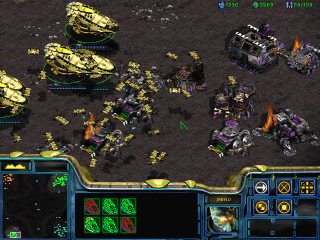
Now the idea of playing it competitively is completely anathema to the motivations that i find to play.  As part of my "i really should play all the games that are considered genre defining if i really want to engage in a game discourse" i found a copy for mac and had a go.  It is good, its really good, and was up until a point.  I got too caught up in the emergent narrative on the battle field and found myself working against the game's main function.  In a mission i was playing the enemy base was situated just across from a body of water from where i was amassing my troops.  So i loaded a bunch of marines up into a dropship:


And i set off for a quick raid on the enemy's resources across the water.  Now i sent the ship carrying its full amount of marines and backed it up with a couple of fighter planes too, they swept in cleared the landing zone and the slower drop ship trundled in behind them.  The marines unloaded as the fighters provided covering fire protected by their cloaking devices making them invisible to the enemy troops, just as their cloaking ability was about to run out i sent them back to base out of harms way, leaving the ground troops to hold the position, the plan was to send the drop ship back to base and bring more men over and hopefully taking and holding this enemy outpost.  However, the enemy could not see my fighters but he could see my slow and very visible dropship and he sent his own fighters to intercept it and take it down, his ships appeared out from a dark area of the map and took out a dropship full of marines, and a lot of the ground troops who i had dropped behind a bunch of large rocks which were giving them cover and providing surprisingly effective positions from which to defend themselves as they were taking out the enemy troops rushing towards them, they were only a small group of six marines by now and as they are relatively cheap troops to produce i should probably just have left them to it, but the whole thing had been too exciting up until now.  The game was providing me with an emergent narrative unfolding in my head i had never expected.  The situation was clear i had men behind enemy lines and they needed rescuing:


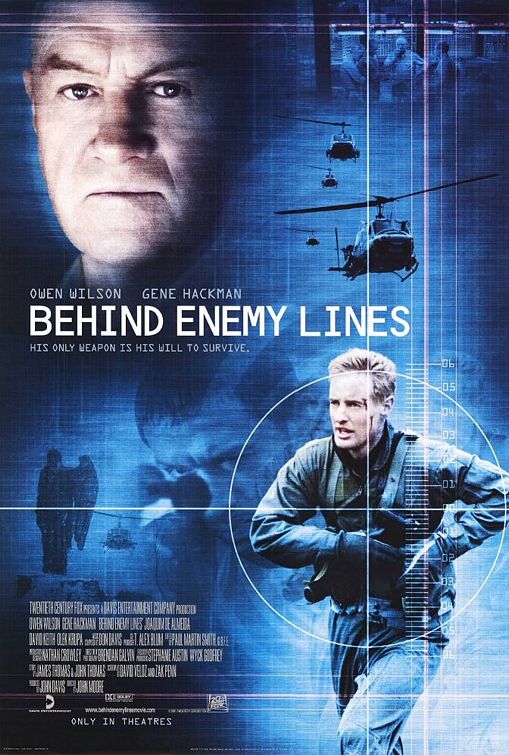
I began the process of building new dropships to send over to pick them up and enough fighters to clear the Landing Zone.  By a strange glitch my stranded marines were insanely well fortified in a way that was simply impossible, so although the computer was pouring troops and robots at them they were maintaining their position incredibly successfully, and although pinned down they were inflicting heavy damage.  But gradually they were being picked off one at a time falling under  a hail of bullets, until there was only one left.  Things were becoming unbearably intense now as i watched the progress bar of the ship build move towards completion, amassed the troops i would be sending over as part of the rescue mission, this was turning into my own Black Hawk Down


The dropship was completed, i loaded up the marines and sent it and a wave of fighters over the water, the fighters piled in first, clearing out some of the heavier opposition and the drop ship dropped its load in the whole that the fighters cleared, a wave of marines who took out the remaining computer skirmishers securing the site.  The last surviving marine was safe loaded into the dropship and taken back to base to an internal soaring soundtrack.

The whole thing took a good ten minutes and was brilliant fun, a great piece of emergent storytelling, which although allowed by the game was really a waste of time in terms of the game's objective as during my rescue mission i'd failed to do any of the task and tend to my army's general development which put me a bit behind in terms of the arms race that is a game of Starcraft and i really had to claw my way back, but i did win the mission.  The problem however is that the one Marine i had fought so hard to save, who had really ben the best bit about my game was now lost within the rest of the relatively faceless army i was controlling on the field, possibly dead i had absolutely no way of turning this into the epic space opera that was burgeoning in  my mind.

And that broke it for me.  Now i had taken most pleasure from my own personal engagement with the game, and developed my own game practice that was in friction with the game's own demands.  I've not really played it much since then as i suspect that i would simply go looking for re-occurrences of potential emergent narratives and would only get frustrated with it.  Does that make my take or practice of Starcraft wrong, well only in the sense that i won't b competing in a tournament anytime soon, but not in the sense that i found my own rules of engagement for the game, and the best interactions should find room for this to happen.  Whereas with World At War i basically became frustrated by the narrow corridor 'fish in a barrel' style of play that left no room for me the player.

I am fascinated by the idea of transgressive play, players developing their own meaning and shifting the paradigm of a particular game through alternative play practice.  Open world games like Grand Theft Auto encourage this just 'messing about' in the world but this is inbuilt into the game, i like the idea of finding your own spatial and narrative practice carving out your own engagement and meaning.

This has long been a key tenent of interactive work for me that it must allow room for the audience/ player to configure or reconfigure the space they are sharing with the work otherwise the interaction is merely a binary gate no more interactive than clicking a button.

We are currently embarking upon making a new piece called 'The Agency', a live piece influenced by board games but purposefully removing the procedural mechanics, in an attempt to create a truly emergent space for the live players to interact both with the world of the game and each other.  The game is the outcome of a lot of the thoughts i have been having on this blog and hope to use a lot of the emergent practices that board games and RTS games employ and bring these to a live setting... please send me any thoughts or anecdotes of your own.


the agency

Welcome to our process blog/diary about the making of 'The Agency' our new game which will premiere at the ICA as part of Sandpit: http://sandpit.hideandseekfest.co.uk/ica-sandpit-2010/
you can follow over to Ben's blog for more in depth posting about some of the thinking behind the piece http://digitalornithology.blogspot.com/ .  This page is a collaborative project and will blur over to other blogs, and hopefully plug into our process as the reception and development of the piece, thanks for reading.
B.

Posted via email from invisibleflock's posterous

Saturday, 24 April 2010

there can only be one


I have a strange relationship to winning.  I don't really know what it is, i get uncomfortable around too much competition, especially sporting competition.  it's never an impulse i've ever had, i was an only child an spent a lot of time playing on my own (not in a bad way i had no brother or sister to play with or more importantly against)  but i played a lot, in fact i remember having my action figures out in room long after other friends of mine had theirs packed away in the garage or off to car boot sales (i also still have a lot of them littered about my house although now i can hide behind the ironic 'object d'art' statement).


the point is i loved to play but was never that bothered about winning probably because i didn't have to be and i think its translated through into my attitude now when i think about and undertake game like activities.  Recently in Cardiff where we performed the first version of our latest game Follow the Bird, the game was followed through to the end by two ladies who were friends, who kept saying "i bet you haven't met anyone as competitive as us".  Truth is i hadn't ever considered the enterprise as one that could be competitive.  On reflection of course it is.  As i mentioned in my previous post the whole idea of creating a series of success gates that naturally cut down the audience amount down to the final one is of course competitive i just had never considered it through that lens.  We're now designing our Bristol game (on the 8th of May look out for the mini game to get your password to play) and working out how many players we can accommodate and the structure of the tasks, knowing that we need to end with a far smaller number than we started with and ultimately with a 'winner' ( although our last winner ended up putting her hand up a chicken as a prize).

Part of the reason i tend to not think about the competition inherent in these things is because i tend to focus more on the experience of playing.  Looking around me at the games i'm studying and playing i read a description of euro games as games where the winner feels that they won through their superior skill and the losers felt they lost because luck was against them.  This is an interesting definition that promotes the experience of play above that of winning or losing, as a successful piece of game design is one that the loser enjoys as much as the winner, the interaction with the game being rewarding enough for both.  That's why a game such as monopoly can be so frustrating, to lose sometimes means being stuck in a downward spiral that you can't get out of and basically being slowly economically smothered to death, and the game is generally considered a bad piece of design.

So in a live game where we lose players through a series of stages how can we create a sense of play that survives them being eliminated?  I'm not sure yet, i think a lot of it is critical to the stages in which they are eliminated.  In his essay on procedural board game play Matthew Kirschenbaum talks about the pleasure of understanding the mechanics of play, so knowing the result of the dice roll and doing the necessary adjustments and calculating the resulting damage on your troops (in the case of a wargame) can be much more satisfying than seeing them get mowed down in computer game that hides the mechanics from you.  So in the case of players if they are aware of the time based nature of some of the tasks and the competitive framework o the early stages of the game, not only is their participation imbued with the agency as afforded by the narrative but also an added urgency of the player to player interaction. 

In our last game the player to player interaction ended up being one of fierce competition even though we had mainly designed the game as a solo endeavor.  We've opened this one up, small teams can play but i don't quite know what to expect in terms of purposefully fostering competition, especially when it becomes apparent that the players may need each other rather than need to beat each other.  In board game terms 'interaction' often means that you have to trade or beat your opponents and as a rule the competitive nature of play interests me less than emergence or co-operation, as I'm never sure what meaning can truly emerge from the base competitive instinct or desire to win, I'm sure there is one i just need to get more comfortable with accommodating it.  So perhaps a word of advice, if you ever play one of our games remember, I'm not sure i like winners and you too may end up with your hand up a chicken